
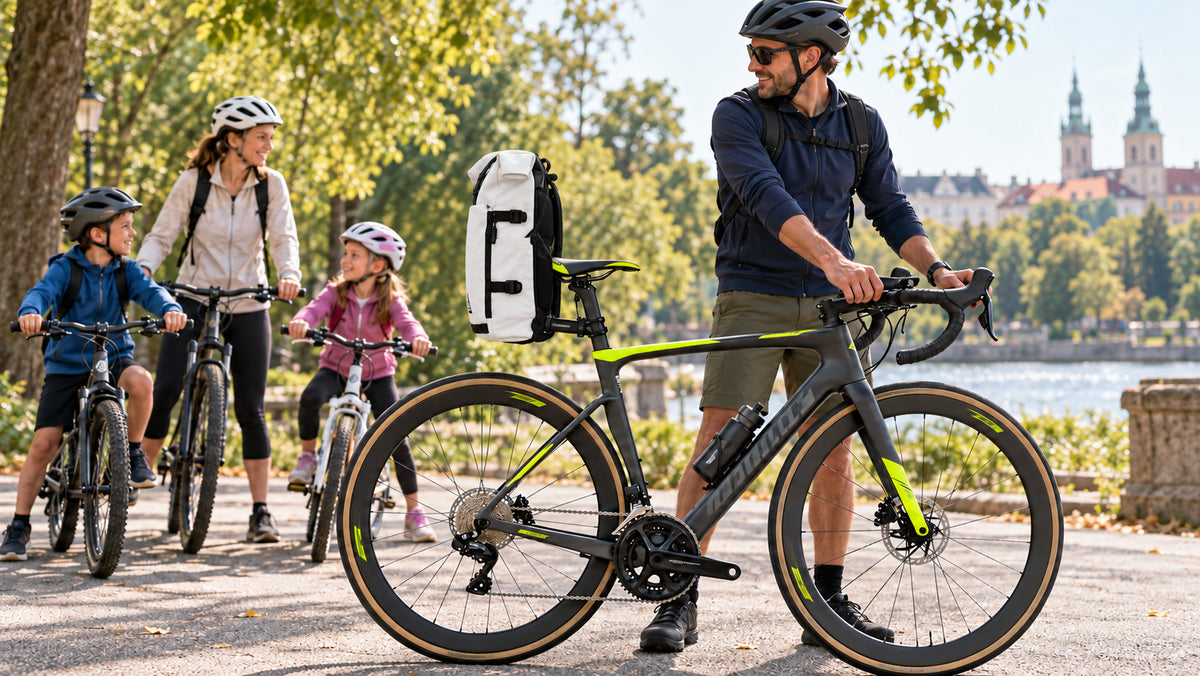
A family bike ride sounds simple until you start packing. Lunch, water bottles, spare clothes for the children and something to sit on at the park. By the time everyone has found their helmets, most of it has ended up in Dad's bag. Sometimes it's Mum's. When you're the only adult on the outing, you're carrying the supplies as well as keeping an eye on the children.
If you're usually the one carrying everything, it helps to choose a cycling backpack around a normal day out. Think about what goes into it, where the weight sits and how you'll carry it once the bikes are parked. A comfortable daypack may be enough for a light load. When you're packing for several people, letting the bike carry the bag takes that weight off your shoulders.
Start with the things you actually take
Before comparing bags, put your usual kit on the kitchen table. A family's afternoon out can mean sandwiches, spare clothes, sunscreen, a small first-aid pouch and puncture tools, as well as everyone's drinks. You soon get a better sense of the space you need.
A compact 10–20L cycling daypack can work well for one person's essentials. Larger cycling backpacks are available too, particularly for commuting.[1] For a family outing, the useful question is whether your lunch and layers fit comfortably, with room to close the bag properly. You don't want to unpack half of it every time someone takes off a jacket.
Check the weight as you pack. A fleece is bulky but light; a full water bottle is the opposite. Share heavier items between the adults' bikes where possible, and use suitable bottle cages for drinks. Extra space is handy, especially for the journey home, but there is no need to fill it.

When an easy ride starts to feel uncomfortable
You might barely notice a backpack at the start. A little later, your shirt feels damp and you're pulling at the straps to give your shoulders a break. The route hasn't become harder, but carrying everyone's things has made it feel that way.
A bag against your back leaves less room for air to circulate. Ventilated panels can help, and a small cycling study found that changes to panel design improved heat transfer.[2] They still leave you carrying the weight. Separate research has linked shoulder-strap forces and contact pressure with discomfort.[3]
If your shoulders or lower back are aching, take that as a reason to reassess the load. Research on military load carriage has recorded back injuries, although those findings cannot predict the long-term injury risk from a family bike ride.[4]
Mounting the bag on the bike gets it off your shoulders and away from your back. You'll still get warm from riding, but you won't have a packed bag pressed against your shirt. Persistent pain or numbness needs attention beyond a change of bag.

Choose a way to carry things that suits your bike
A backpack is convenient when the load is light and you're hopping on and off the bike. As the family packing list grows, panniers or a backpack that mounts to the bike are worth a look.
| Option | When it makes sense | What to consider |
|---|---|---|
| A regular bike backpack | Short outings with a few essentials. | Easy to take anywhere, though your body carries the weight throughout the ride. |
| Panniers on a rear bike rack | You already have a rack or often carry a larger load. | Check the fittings, heel clearance and how you'll carry the bags after parking. |
| A rack-free bike-mounted backpack | You want your back clear and one bag to take along at stops. | Check the mounting requirements and the space behind your saddle. |
If you already have a suitable bicycle rear rack, panniers may be the easiest place to start. They take the load off your body, and some have straps that make them easier to carry around town. A setup that already works for your family may need very little changing.
If you don't want a traditional rack, look at how the alternative attaches. A seatpost bike rack still has a platform for luggage. A bike-mounted backpack can use its own dedicated support instead. Either way, check the installation requirements before buying.
A small saddle bag is useful for puncture tools and other essentials. Just check its capacity before counting on it for the picnic as well.
When the bike ride turns into a walk
You might ride from home to a park, lock up near a trail entrance and spend the next hour exploring on foot. For a family of four, that means parking four bikes, helping the children get ready and taking along the water, snacks and spare layers. With one adult looking after the children, an easy changeover matters even more.
Choose somewhere bicycles are allowed to be parked, and lock the frames and wheels to a suitable fixed anchor. Carrying a detachable bag does not solve bicycle security. Take valuables with you, and check the parking arrangements before planning a walk away from the bikes.
With panniers, the next step depends on their design. Some convert into backpacks or have comfortable carrying straps. Others are convenient on the bike but awkward to carry along a trail, especially if you need a hand free for a child. You may prefer to move the walking essentials into a separate daypack. Consider that extra bag when packing at home.
With the EasiCyco Roll-Top, you can park and lock the bike, detach the bag and adjust its shoulder straps for the walk. Lunch, clothing and valuables stay together, so there is less to transfer beside the bikes. When you return, attach the bag again according to the mounting instructions and check that it is secure before riding home.
Once the bag is on your back, you are carrying its weight again. A roomy cycling bag is not automatically comfortable for a long hike. Pack for the walking part too: leave out non-essentials, keep water and snacks easy to reach and share the load if another adult is with you. A short park walk and several hours on a trail call for different packing choices.
How the EasiCyco Roll Top fits into a family day out
The EasiCyco Roll-Top Cycling Backpack in white offers 30L of space, expanding to 40L when you need more room. It comes with its mounting kit and sits behind the saddle without a traditional rear rack. At a cafe, park or trail entrance, you can detach it and use it as a backpack.[5]
That makes it worth considering for bulky family supplies, provided it fits your bike. The standard setup requires a round seatpost of 25–35 mm, a dual-rail saddle and enough installation space. Non-round posts need additional accessories. If you use a child seat, check compatibility rather than assuming both will fit behind the saddle.
The listed dimensions are 58 × 32 × 22 cm, and the bag's listed weight is about 2.05 kg (4.519 lb). Allow for the bag and hardware when planning your load. The published maximum is 15 kg; stay within any lower limit for your bike or components. IPX5 water resistance and an included rain cover provide weather protection.[5]
For weekend use, the appeal is having space for spare layers and lunch, then taking the same bag with you when you stop. Use small pouches to keep clothing separate from food and make essentials easier to find. Leave enough room to roll and fasten the top as instructed.

Give the packed bike a quick try before setting off
Once everything is packed, secure the contents as the mounting instructions recommend. Tuck away loose straps, check clearance above the rear tyre and make sure the bag doesn't hide your rear light.
Then take a short ride close to home. Turn, brake and get on and off with the actual load attached. Luggage can change how the bike feels, and it's easier to make adjustments before everyone is waiting by the gate.
Choose a bag that holds what your family needs and is manageable on the bike and on foot. With the packing sorted, you can spend the afternoon deciding where to stop for ice cream instead of wondering how soon you can take the bag off.
Sources
- deuter cycling backpack range. Includes compact riding packs and larger commuting designs.
- Michel FI and colleagues (2019). Influence of an engineered backpack ventilation technology on thermal comfort during cycling. Journal of Science and Cycling, 8(2), 9–12. Pilot study with four participants.
- Wettenschwiler PD and colleagues (2015). Mechanical Predictors of Discomfort during Load Carriage. PLOS ONE, 10(11), e0142004.
- Orr RM and colleagues (2015). Reported load carriage injuries of the Australian army soldier. Journal of Occupational Rehabilitation, 25(2), 316–322. Occupational evidence, not a recreational cycling study.
- EasiCyco Roll-Top Cycling Backpack product specifications. Checked 24 September 2026.